

Emission Impossible: Corporate Climate Goals Moving from Adoption to Execution
This report draws on executive insights and disclosure data from US public companies to assess where corporate climate targets are credible, where emissions trends are off track, and what business leaders should do to govern, track, and communicate climate commitments more effectively.
Trusted Insights for What’s Ahead®
- Setting climate goals is a mainstream large-company practice. Some 84% of S&P 500 companies disclosed a climate target in 2025, compared with 34% of the Russell 3000.
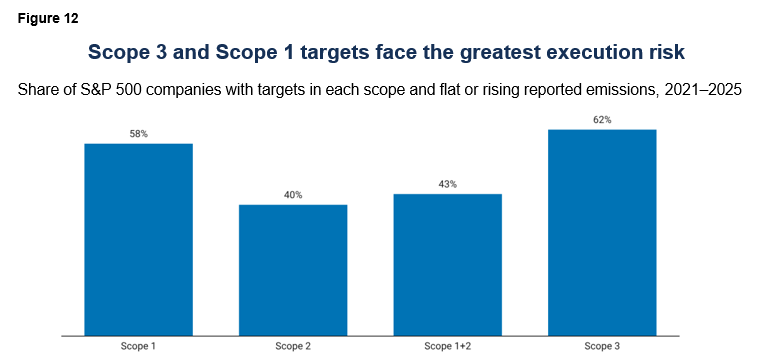
- Many climate targets are at risk. About 58% of S&P 500 companies with Scope 1 (direct emissions from operations) targets and 62% with Scope 3 (indirect value chain emissions) targets have reported flat or rising emissions since 2021, while only 24% of polled sustainability leaders are fully confident in their goals.
- Scope 1 remains the hardest operational challenge. Median Scope 1 emissions fell 41% across the Russell 3000 from 2021 to 2025 but were flat among S&P 500 companies, and utilities saw emissions rise in 2025 as power demand increased.
- Scope 2 (indirect emissions from purchased electricity) is the clearest bright spot. Median S&P 500 location-based Scope 2 emissions fell about 39% from 2021 to 2025, while market-based emissions fell about 59%, highlighting the role of renewable electricity procurement and other market instruments.
- Scope 3 remains the biggest credibility gap. Among S&P 500 companies, 82% disclose Scope 3 emissions, but only 33% have an explicit Scope 3 reduction target.
- Climate targets are increasingly competing for capital. Our research found that 55% of polled executives cite “capital allocation, cost, or ROI” as a likely reason their organization may adjust or delay targets.
Current State of Corporate Climate Goals
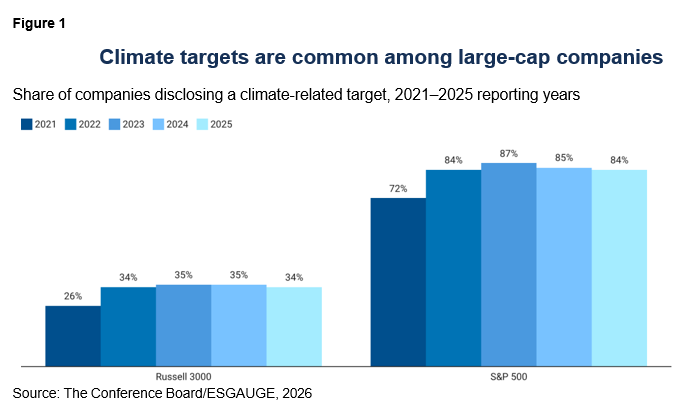
Climate-target disclosure is well established at large US public companies, with 84% of S&P 500 companies disclosing in 2025. In the broader Russell 3000, the share was much lower, at 34%, and has been largely flat since 2022. That gap indicates correlation of climate goals with company size, reporting capacity, investor scrutiny, and sustainability-program maturity.
A closer look at recent S&P 500 disclosures shows that “having a climate target” can mean very different things (Figure 2). Some companies set a broad aspiration, while others specify the emissions covered, the reduction level, the baseline, and the deadline. The largest gap remains Scope 3, or value-chain emissions, where companies often have less control and weaker data.


There is also an emerging gap between setting climate targets and internal confidence in delivery. In recent polling by The Conference Board of corporate sustainability executives, only 24% said they were “confident across most scopes and pathways”; most said “some targets on track, others uncertain” (Figure 3).
Confidence is highest where companies have more control, better data, and clearer tools, such as energy efficiency, renewable electricity, and operational emissions. It typically falls where progress depends on suppliers, customers, product use, financed emissions, grid capacity, or evolving standards. As a result, corporate climate goal setting is entering a more disciplined phase focused on feasibility, execution, and credibility.
Greenhouse Gas (GHG) Emissions: Understanding Scopes 1, 2, and 3
GHG emissions—primarily carbon dioxide, methane, and nitrous oxide—trap heat in the atmosphere and contribute to global warming. Companies are significant emitters and track these emissions to comply with regulations, meet investor expectations, and manage related financial and operational risks. Emissions are classified into “scopes” based on their source:
- Scope 1: Direct emissions from assets the company owns or controls, such as fuel combustion in company vehicles or on-site manufacturing.
- Scope 2: Indirect emissions from purchased electricity, steam, heating, and cooling. These are reported as both location based (reflecting the local power grid’s average emissions) and market based (reflecting specific energy contracts, such as renewable energy certificates).
- Scope 3: All other indirect emissions across the value chain, upstream and downstream, and typically the majority of emissions for many firms. Scope 3 spans categories from supplier emissions to product end-of-life impacts, making it difficult to measure and variable by industry.
Progress on Emissions Reduction
GHG emissions disclosure

GHG emissions reporting is well established among large-cap US companies (Figure 4). Regulation is a major driver, with new and emerging rules mandating disclosure and, increasingly, external assurance of the underlying data. Despite ongoing efforts to rescind the US Securities and Exchange Commission’s 2024 climate disclosure rule,[1] momentum has continued through state-level requirements—especially in California[2]—as well as European and international rules[3] affecting large multinationals.
Progress on Scope 1 (operational) emissions

Russell 3000 companies show notable progress on reducing Scope 1 emissions, with median reported emissions down 41% from 2021 to 2025, despite a small uptick in 2025. S&P 500 firms show a flatter trend: median Scope 1 emissions are down from a 2022 peak but are essentially unchanged from 2021 (Figure 5.)
Among the S&P 500, notable companies that reported significant Scope 1 reductions between 2021 and 2025 include 3M (-58%), AT&T (-48%), and McKesson (-39%). These reductions likely reflect company-specific operational shifts, as well as changes in data capture and calculation methodology: 3M has been cutting emissions across a large manufacturing base through energy and process-efficiency projects; AT&T’s Scope 1 progress is closely tied to fleet reductions; and McKesson’s decline likely reflects a mix of facilities, fleet, and portfolio changes.
Scope 1 emissions are heavily concentrated in the utilities and energy sectors, with utilities in a category of their own (Figure 6). Utilities firms reported meaningful average reductions through 2024 before increasing in 2025, likely reflecting higher electricity generation as demand grew across residential, commercial, and industrial customers, including data centers. In that environment, utilities may need to run more gas and, in some cases, generate more coal to meet load, even as long-term decarbonization plans remain in place.

Progress on Scope 2 (purchased electricity) emissions
Since 2021, US public companies have made the clearest reported progress on emissions from purchased electricity (Figure 7), with declines under both “location-based” and “market-based” accounting. Location-based Scope 2 reflects the emissions intensity of the grids where companies operate. Market-based Scope 2 reflects companies’ electricity procurement choices, such as renewable energy contracts, green tariffs, power purchase agreements, and renewable energy certificates.[4]
Declines in both measures suggest a combination of cleaner grids, energy-efficiency measures, facility changes, and more active renewable electricity purchasing. The sharper decline in market-based emissions also shows that recent corporate climate progress has relied significantly on instruments used to lower reported electricity emissions, not only on physical grid decarbonization where and when electricity is used.

Scope 2 reductions are critical to many climate targets. However, proposed updates to the GHG Protocol’s Scope 2 guidance may make further reductions harder to claim by requiring stronger evidence that purchased clean electricity matches consumption by time and location. Companies reliant on annual renewable electricity procurement may see smaller reported reductions, more volatility, or a need to revise targets, procurement strategies, and data systems.[5] Several S&P 500 firms, including NVIDIA and T-Mobile, reported zero market-based Scope 2 emissions in 2025 despite substantial location-based emissions.
Overall, progress on Scope 2 supports a positive message, while underscoring that climate goals are becoming more dependent on the power system. Achieving Scope 2 targets will increasingly require cleaner grids, expanded transmission, and enough renewable generation to support existing demand and new load from electrification, data centers, and industrial growth.
Progress on Scope 3 (value chain) emissions

Scope 3 emissions—indirect emissions across a company’s value chain—often represent the largest share of total corporate emissions. The GHG Protocol breaks Scope 3 into 15 categories, including upstream sources and downstream uses.
Measuring these emissions is difficult because companies often rely on supplier, customer, logistics, product-use, or financed-emissions data that they do not directly control. Data quality can vary significantly across counterparties, and companies may depend on proxies, averages, estimates, or emission factors rather than primary data.
Verification is similarly challenging, particularly across complex supply chains. For example, changes to transport and distribution emission factors recently altered eBay’s Scope 3 trajectory, forcing a choice between comparability with prior years or updated assumptions.[6]
At face value, median Scope 3 emissions have risen year over year among Russell 3000 companies but stayed flat for the S&P 500 (Figure 8). However, the increase among smaller and midsize firms may reflect expanded disclosure, improved estimation methods, and broader category coverage rather than actual emissions growth. Conversely, the relative stability in S&P 500 data may signal more mature reporting systems or consistent assumptions.
Industry-level variation is notable, with the energy sector far exceeding others in Scope 3 emissions (Figure 9), driven largely by downstream use of sold products. Other sectors face different exposures: manufacturing and consumer goods through supply chains and product design; financial services through financed emissions; technology through purchased goods, electricity, hardware, and cloud demand.

Are Corporate Climate Targets at Risk?
Emissions trends raise a harder question: Are today’s climate targets durable enough for the next phase of execution? The evidence presented above points to rising execution risk rather than broad abandonment. Many corporate climate targets were set under earlier assumptions now under pressure: cheaper capital, stronger policy momentum, simpler renewable electricity claims, slower power-demand growth, and more time before 2030 milestones.

In recent polling of corporate sustainability executives, the leading pressure cited on climate targets was financial (Figure 10). “Capital allocation, cost, or ROI considerations” were selected by 55% of respondents as a factor likely to prompt significant adjustment or delay. “Evolving regulatory or disclosure requirements” followed at 45%, and “technology readiness or availability of viable abatement solutions” at 37%. Policy scrutiny, standards changes, and legal or litigation risk were also material concerns.
These are practical business constraints. Decarbonization projects now compete with AI, digital transformation, cybersecurity, capacity expansion, supply-chain resilience, and margin protection. Projects that might have cleared approval when capital was cheaper now face tighter hurdle rates, shorter payback expectations, and closer finance review.
The ongoing AI boom has intensified this pressure directly through rising electricity demand, data center buildout, and value-chain emissions, and indirectly by competing for the same capital, clean power, grid capacity, and management attention needed to deliver climate targets (Figure 11).[7] Recent sustainability disclosures from major cloud providers illustrate this tension: Google reported a 37% increase in electricity demand in 2025 as its AI buildout accelerated, while Amazon’s Scope 2 emissions rose 34%, with data center electricity use a major driver.

Importantly, among S&P 500 companies with reported Scope 1 targets, 58% reported flat or rising Scope 1 emissions between 2021 and 2025 (Figure 12). Among companies with Scope 3 targets, the share reporting flat or rising Scope 3 emissions was at 62%. The share was lower for Scope 2, at 40%, where renewable electricity procurement and efficiency measures have helped more companies show progress.
While these figures do not prove or guarantee that a company will miss its target, they do show that a significant majority of large-cap US public companies’ climate goals are currently on an “at-risk” trajectory. They also point to different types of risk: Scope 1 targets are primarily exposed to operational, capital, technology, and asset-turnover constraints, while Scope 3 targets are exposed to value-chain influence, third-party performance, and data reliability.
Where emissions are flat or rising despite a publicly disclosed climate target, leaders should identify the cause. For Scope 1, the core question is whether companies can reduce direct operational emissions through capital investment, equipment upgrades, process changes, fuel switching, efficiency measures, facility decisions, or new technologies without compromising growth or reliability. For Scope 2, the challenge increasingly lies in electricity procurement, grid constraints, accounting rules, and access to credible clean power. For Scope 3, the issue is whether companies have enough influence over suppliers, customers, financed entities, logistics providers, product design, or product use—and whether the data are reliable enough to demonstrate real progress.
Recognizing the growing challenges and evolving landscape around corporate decarbonization, the Science Based Targets initiative (SBTi)—the primary global body responsible for validating corporate climate targets as credible and aligned with climate science—recently updated its corporate net-zero standard to provide more flexibility, while introducing higher expectations on data, governance, transition planning, progress tracking, and defensible claims.[8]
What Happens When Climate Targets Change
The target-risk evidence cited above suggests that many corporate climate targets will need more capital, clearer execution plans, or recalibration before 2030. “Recalibration” is not automatically a rollback and may reflect better data, a changed business mix, new accounting standards, higher capital costs, technology delays, grid constraints, or more realistic assumptions about the path to delivery. As 2030 moves from a long-term milestone to a near-term deadline, companies will also need to decide whether and how to define credible 2040 and 2050 targets or transition pathways for the next phase of decarbonization.
What matters is the nature of the change and how clearly the company explains it. Investors and lenders will focus on financial risk, capital needs, transition exposure, and management credibility. Customers may care where supplier targets affect their own Scope 3 inventories, procurement scorecards, or product claims. Regulators, assurance providers, and legal teams will focus on accuracy, consistency, and substantiation. Employees, communities, NGOs, and the media may respond more strongly if a change appears inconsistent with prior messaging.
Companies should distinguish among three types of target change:
- Technical recalibration: updates to baselines, boundaries, calculation methods, emission factors, or reporting structures while preserving the underlying ambition. The company should explain the change and, where possible, provide a bridge from old to new metrics.
- Feasibility reset: changes to the time frame, scope, target level, or pathway because original assumptions no longer hold. The company should explain what changed, what remains in place, and how the revised pathway will be funded and governed.
- Strategic retreat: reduction in ambition, removal of a target, or deprioritization of climate action without a credible replacement plan. This carries the greatest reputational, commercial, legal, and employee-relations risk.
Target changes should not happen through report drafting alone. Material changes should be reviewed by sustainability, finance, legal, operations, investor relations, communications, relevant business units, and the board. The review should answer four questions: What has changed? Does the change affect ambition or accounting? How will comparability be preserved? What will management do next?
Communicating and Disclosing Climate Goals
As targets come under more scrutiny, companies are changing not only how they set climate goals, but how they communicate them. The direction is toward more discipline, clearer substantiation, and less tolerance for broad claims that are not tied to execution.
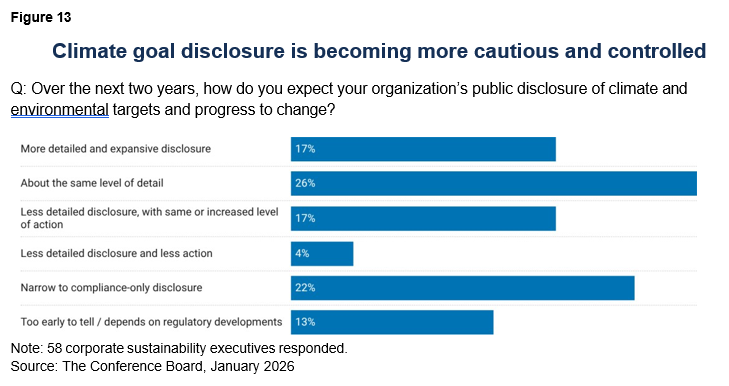
Polling of corporate sustainability executives points to a more cautious and uneven disclosure environment (Figure 13). Few companies appear to be pulling back on climate action outright, but many are becoming more selective about what they say publicly and how they say it. Some expect to provide more detail, while others expect disclosure to become more compliance driven or less expansive even if underlying work continues.
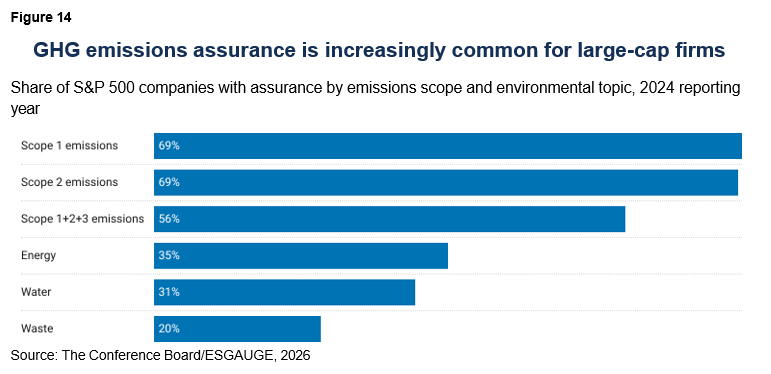
External assurance is increasingly part of that process. Assurance typically involves an independent provider reviewing emissions data, methodologies, controls, and calculations against defined reporting criteria and is becoming more common as regulators, investors, customers, and boards seek greater confidence in climate disclosures.[9] In 2024, about 7 in 10 S&P 500 companies had assurance over Scope 1 and Scope 2 emissions, with more than half also assuring Scope 3 emissions (Figure 14).
However, a company can have assured emissions data and still be off track against a target. Assurance tells stakeholders the data have been reviewed; it does not say emissions are falling, the pathway is funded, or the target is achievable.
Ultimately, the most credible climate goal disclosures will differentiate between:
- Ambition: long-term goals, such as net zero,
- Targets: time-bound commitments with defined baselines, scopes, and metrics,
- Progress: actual emissions movement, procurement activity, capital projects, or operating changes, and
- Uncertainty: dependencies on technology, suppliers, customers, grid capacity, standards, or business growth.
Those distinctions are important, as a net-zero ambition, 2030 emissions target, renewable electricity claim, and Scope 3 estimate do not carry the same level of control or evidence. Companies should also explain movement in the data: if emissions rise, the disclosure should make clear whether the driver is business growth, acquisitions, expanded Scope 3 coverage, improved supplier data, delayed projects, energy demand, or methodology changes. If a target changes, the company should explain whether it is a technical recalibration, feasibility reset, or reduction in ambition.
Corporate Environmental Goals Beyond Climate
Climate is the most developed area of corporate environmental target-setting. Looking beyond climate, other environmental goals are advancing but are also less standardized and more dependent on sector, location, product design, and supply-chain exposure (Figure 15).
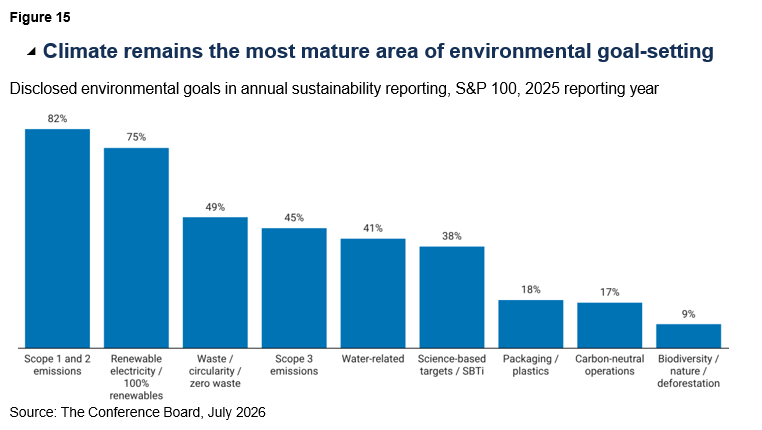
Benchmarking of annual sustainability disclosures among S&P 100 companies (the 100 largest publicly traded US firms) shows that environmental goal-setting is most prevalent where measurement and control are clearest (Figure 15). In 2025, 82% of S&P 100 companies disclosed Scope 1 and 2 emissions targets, and 75% disclosed renewable electricity targets.
Disclosure was less common for more complex or value-chain-dependent areas: Scope 3 emissions at 45%, water at 41%, packaging and plastics at 18%, and biodiversity at 9%.
That pattern reflects differences in measurability, operating control, and business relevance:
- Waste: Goals tend to be operational and measurable, often focused on landfill reduction, diversion, recycling, circularity, or facility-level material streams.
- Water: Goals need local specificity. A site-level goal in a water-stressed basin may be more useful than a broad enterprise reduction target.
- Packaging and plastics: Goals are closely tied to product design, recycled content, recyclability, material reduction, phaseouts, and regulatory trajectory.
- Nature and biodiversity: Goals remain earlier stage, often focused on deforestation, restoration, regenerative practices, conservation, or supply-chain exposure before enterprise-wide targets are credible.
Companies should start where exposure is material, baselines are credible, control or influence exists, and progress can be measured. A narrow, well-governed goal tied to real business exposure is more useful than a broad environmental commitment without a baseline or execution pathway.
Conclusion: What Business Leaders Should Do Now
Corporate climate targets are moving from aspiration to execution. Adoption is broad, disclosure is mature, and scrutiny remains high. However, progress is also uneven, Scope 3 remains underdeveloped, and many targets now face growing pressure from capital constraints, energy demand, technology readiness, standards changes, and value-chain complexity.
Business leaders can navigate these challenges by focusing on five priorities:
- Manage targets as commitments. Every public goal should have an owner, baseline, method, data source, capital pathway, assurance status, and change history.
- Reforecast near-term targets annually and set longer-term pathways. As 2030 nears, companies should reassess targets against emissions trends, growth, capital plans, procurement, supplier progress, AI-related demand, standards exposure, and funded abatement, while deciding whether 2040 or 2050 pathways are needed.
- View Scope 2 as energy strategy. Renewable electricity instruments remain important, but credibility will increasingly depend on time, location, grid conditions, storage, demand flexibility, and clean firm power.
- Prioritize Scope 3 by materiality and influence. Companies should focus where emissions matter most and where they can act through procurement, product design, supplier capability, customer engagement, financing, logistics, or portfolio decisions.
- Communicate with restraint and substantiation. The strongest disclosure explains what the company controls, what it influences, where progress is uneven, what assumptions have changed, and how management is responding, while reducing the risk that climate claims are viewed as overstated, unsupported, or misleading.
About This Report
This report examines the current state and trajectory of corporate climate goals. It is informed by multiple inputs, including:
- Extensive longitudinal data on US public company climate disclosures, including climate goals and emissions data, by The Conference Board and data analytics firm ESGAUGE.
- Benchmarking of S&P 100 environmental goal disclosure by The Conference Board.
- Insights from a January 2026 Chatham House Rule roundtable convened by The Conference Board Governance & Sustainability Center on setting and disclosing environmental goals.
1In March 2024, the SEC adopted final climate-disclosure rules requiring registrants to disclose material climate risks, governance and risk-management processes, certain targets and transition plans, specified severe-weather and related financial-statement effects, and, for larger filers where material, Scope 1 and Scope 2 emissions with phased assurance. The SEC stayed the rules in April 2024 pending judicial review; they never became operative, and the agency proposed rescinding them in full in May 2026.(go back)
2California has become the leading US state-level climate disclosure driver. SB 253 requires public and private companies with more than $1 billion in total annual revenue to disclose Scope 1 and Scope 2 emissions beginning in 2026, with Scope 3 disclosure beginning in 2027 and phased assurance. SB 261 separately requires covered companies to publish climate-related financial risk reports, although this law is currently on hold pending litigation.(go back)
3The EU’s Corporate Sustainability Reporting Directive requires in-scope companies to report sustainability risks, impacts, policies, metrics, and targets using the European Sustainability Reporting Standards, including GHG emissions data if considered material. Scope and timing were recently reset under the Omnibus directive.(go back)
4Scope 2 emissions cover purchased electricity, steam, heating, and cooling. Under the GHG Protocol, companies generally report them two ways. The location-based method uses average grid-emission factors where energy is consumed, showing exposure to the physical power system. The market-based method uses company-specific electricity purchases or contractual instruments, such as green tariffs, power purchase agreements, and renewable energy certificates. Dual reporting shows both grid exposure and the effect of energy procurement choices.(go back)
5The GHG Protocol is reviewing its Scope 2 Guidance. Proposed updates could require stronger evidence that clean electricity is matched to consumption by time and location. No final revised standard has been issued as of June 2026, but the direction of debate points to higher data demands, more scrutiny of annual renewable-electricity claims, and possible changes to Scope 2 targets and procurement strategies.(go back)
6In May 2025, eBay’s 2024 Impact Report used revised Global Logistics Emissions Council (GLEC) emission factors to calculate Scope 3 transport and distribution emissions, putting the company off track against its 2030 reduction goal. eBay later updated the report to use earlier GLEC factors, with a footnote saying the change was intended to “facilitate comparability” with prior years. The episode illustrates a broader Scope 3 challenge: updated emission factors can materially change reported progress even when underlying business activity has not changed. For more, see Jim Giles, Why eBay’s emissions spiked after carbon accounting rules changed, Trellis, June 2026.(go back)
7The International Energy Agency (IEA) estimates that data centers consumed about 485 terawatt hours (TWh) of electricity globally in 2025, roughly 1.5% of global electricity use, and projects consumption will nearly double to about 950 TWh by 2030. AI-focused data centers are growing faster than the sector overall, though the IEA notes that value-chain bottlenecks may limit more aggressive near-term scenarios despite strong investment and project pipelines.(go back)
8The SBTi has released its
9External assurance means an independent assurance provider reviews emissions data, calculation methods, controls, and reporting criteria. It can improve confidence that reported data were prepared consistently, but it is not a finding that emissions are falling, that a company is on track, or that a target is financially or operationally achievable. Assurance requirements are increasingly embedded in climate disclosure regimes, including California’s SB 253 and European sustainability reporting.(go back)
This article is based on corporate disclosure data from The Conference Board Benchmarking platform, powered by ESGAUGE.
Legal Disclaimer:
EIN Presswire provides this news content "as is" without warranty of any kind. We do not accept any responsibility or liability for the accuracy, content, images, videos, licenses, completeness, legality, or reliability of the information contained in this article. If you have any complaints or copyright issues related to this article, kindly contact the author above.
