

Inside Climateworks Centre’s event on corporate climate transition planning
Corporate climate transition planning is fast becoming a core business necessity.
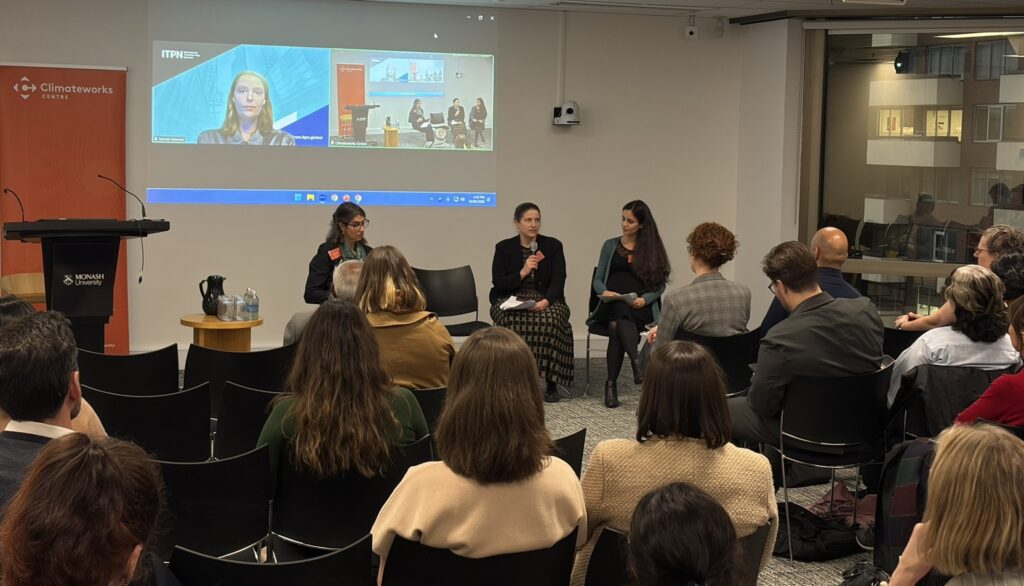
To support Australian businesses through this shift, Climateworks Centre hosted an event providing direct insights into upcoming government guidance and how businesses can use transition planning to strengthen long-term resilience.
The event included a facilitated panel of corporate and investment leaders who shared practical insights, challenges and key lessons from their own transition planning journeys.
The conversation highlighted that while climate information is complex and involves a forward-looking view of an uncertain future, the transition planning process is not that different from standard business planning. It also builds off skills and knowledge that companies already have.
Attendees reported leaving with a clear understanding of the transition planning process and its strategic value. They also gained practical strategies from industry leaders to overcome implementation challenges, along with the motivation to kickstart the process within their own organisations.
Global trends and good practice transition planning in Australia
Monet Mooney, Policy Advisor at the International Transition Plan Network (ITPN), opened the event with an overview of the growing global momentum behind transition plan requirements.
Drawing on the ITPN’s latest research, Mooney outlined five key ways transition plans can mobilise finance, making it clear that transition planning is not a regulatory burden, but a vital strategic management tool.
She also detailed the value robust planning creates for both businesses and investors.
Edlyn Gurney, Director in the Sustainable Finance Branch at the Australian Treasury, then shared what to expect from the government’s upcoming voluntary transition planning guidance – a key priority of the Sustainable Finance Roadmap.
Gurney explained that transition planning is the internal process organisations use to identify and respond to climate-related risks and opportunities, and decide how they intend to deliver on their climate ambitions.
Approaches to transition planning – and the extent to which climate is incorporated into overall business strategy – will vary depending on each organisation’s circumstances. These include size and complexity, sector, value chain, and their identified climate-related risks and opportunities.
Gurney noted that Treasury’s upcoming guidance is designed to take a practical approach to supporting organisations to undertake this internal process, including the use of examples and signposting to relevant tools and resources.
Marine Dehayes, Program Impact Manager of Climateworks’ Sustainable Corporates team, closed the speaker presentations by discussing the value of making transition plans public.
She emphasised that disclosure is far from a checkbox exercise; rather, it acts as ‘a forcing function that guarantees the quality of the planning.’
Transparent disclosure yields significant benefits. It activates the value chain, signals to the market that a business understands its climate-related risks and opportunities, and builds trust with lenders and investors.
Public disclosure ultimately drives a robust, thorough transition planning process.
Dehayes also emphasised that the credibility of a transition plan is vital to ensure corporate targets are both ambitious and actionable. She recommended Climateworks Centre’s guide as a key resource for companies and investors to build and assess that credibility.
From theory to practice: lessons from early movers
The second half of the event featured a practitioner panel, moderated by Climateworks CEO Anna Skarbek AM.
This session brought a practical lens to the conversation.
Corporate and investor experts shared their real-world experiences, early challenges and day-to-day approaches to implementing transition plans.
The panel featured a range of industry perspectives, including:
- Alison Read – Senior Climate and Environment Specialist, Telstra
- Akaash Sachdeva – General Manager, Responsible Investment, HESTA
- Elspeth Taylor – Program Manager, Net Zero Academy, Climateworks Centre.

Three core themes emerged:
1. Overcoming initial inertia: progress over perfection
For many organisations, knowing where to begin can feel overwhelming, with progress often stalling in the initial stages.
Elspeth Taylor noted that successful organisations often draw on external frameworks for guidance and that the necessary data and resources are often already within the business.
Her advice was clear: Do not let the pursuit of perfection cause paralysis. It is far better to begin with an imperfect plan and iterate than to delay action.
2. Navigating long-term uncertainty
Standard corporate strategies rarely focus on a three- to five-year outlook.
Extending this to 10 or 15 years, as required for net zero targets, is more complex.
Gathering meaningful forward-looking data across these extended timeframes remains a challenge for both internal and external stakeholders.
To bridge this gap, Read emphasised the value of mapping out ‘known knowns’ and ‘known unknowns’.
As industry, environmental and economic conditions will inevitably shift over the next 25 years, understanding the foundational modelling assumptions is critical.
3. Activating organisational strategy
The panel highlighted that robust transition planning delivers value beyond simply managing risk.
When treated as an ongoing process, rather than a static document, the internal conversation shifts from ‘making a plan that is then set aside’ to a living document that leadership uses to guide business decisions.
Active and supportive leadership underpins this shift.
Panellists noted that when senior leaders are deeply involved, transition planning becomes a core driver of capital allocation and business decision-making.
Next steps
To help businesses navigate their next steps, participants were encouraged to:
Legal Disclaimer:
EIN Presswire provides this news content "as is" without warranty of any kind. We do not accept any responsibility or liability for the accuracy, content, images, videos, licenses, completeness, legality, or reliability of the information contained in this article. If you have any complaints or copyright issues related to this article, kindly contact the author above.
